
Rolling out EOS
The implementation of EOS (Entrepreneurial Operating System) starts in the management team, but the next step should involve the entire company. The ultimate goal is for all employees to know and use the EOS tools, disciplines and methods.
This article explains what a rollout of EOS entails, why it is important and how it can be successfully implemented.
What does rolling out EOS mean?
During the first three sessions of the EOS implementation - the Focus Day and the two Vision Building Days – basic tools and disciplines are introduced:
- V / TO
Eight questions that define the company's vision in a clear and comprehensible way. - Accountability Chart
Structures the organization by means of functions, responsibilities and GWC (Gets it, Wants it, Capacity to do it) to ensure that every person is in the right seat. - Rocks
Three to seven quarterly priorities to create more focus and achieve more. - Meeting Pulse
Strategic quarterly meetings and weekly operational or tactical L10 meetings with a fixed agenda. - Scorecard
5 to 15 indicators that measure the pulse of the organization, ideally using more Leading Indicators that predict future results than Lagging Indicators to show achieved results.
These are the 5 basic disciplines and tools of EOS. The aim of rolling out EOS is to ensure that the entire organization is familiar with these tools and uses them successfully.
Why should you roll out EOS?
At first, the management team starts working with EOS. However, its effect will be so much bigger if everyone in the company uses the simple but effective tools. The advantages at a glance:
- Easier corporate management
- Faster, more targeted execution
- Greater team satisfaction and fewer staff changes
- Bigger capacity for growth
- General increase in the value of the company
How do you roll out EOS?
During our first session, the Focus Day, I always explain that I have three roles: teacher, facilitator and coach. As a teacher, I present the EOS tools and disciplines. The facilitator integrates the business context into the EOS model and guides debates, and a coach observes and comments to strengthen the team, like a soccer coach, for example.
When rolling out EOS, students become teachers, facilitators and coaches. The managers take the tools to the next level of the organization, which is also a good test to see to what extent they have understood and internalized said tools. The process is similar to the implementation of EOS in the management team, except that it is somewhat shorter. To refresh your memory, here is the process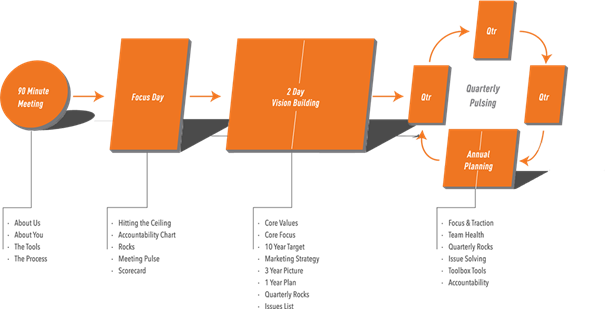
And this is what the different steps look like at the next level:
- 90 Minute Meeting
During this meeting, the EOS model is presented to the team: the six key components and the associated tools. Instead of 90 minutes, it is sufficient to schedule 60 minutes. The aim is for all employees to understand the EOS model.
Note: You may want to consider whether EOS should be introduced as “OOS”, i.e. “Our Operating System”. In this case, the first O is replaced by the initials of the company. For example, EOS for Smith Logistics would be called SLOS (Smith Logistics Operating System). - Focus Day
The following four disciplines are presented at a team meeting: Accountability Chart, Rocks, L10 and Scorecard. The concept of “Hitting the ceiling ”, which we looked at on the focus day, is optional. Be open about the fact that you are still learning about EOS and that not everything will be perfect at the beginning. As with the sessions with me, the goal is to achieve 80% in each discipline.
Just like the previous point, you will probably need less time than we did for our focus day with the management team. A half day is usually enough.
You can take the agenda from the Leadership Team Manual and implement it as it is. - Vision Building
We spent two days on this part with the leadership team. However, as the company's vision has now been defined and written down in the V/TO, there is little work to be done at this point. The meeting is mainly about explaining the vision in detail, answering questions and explaining nomenclature.
However, the session should be used to resume and continue the work of the half-day focus day with the team. If there are still open points at the end, these are added to the issue list.
As before, the agenda for this day can be taken from the Leadership Team Manual.
- Quarterly Meeting
From this point on, quarterly meetings are held with the team; they have the following objectives:
The agenda can once again be found in the LTM. At department level, this meeting is typically much shorter than with the leadership team and takes around half a day.
The order in which the quarterly meetings are held is important and depends on the level in the Accountability Chart:
- Preparation: The department head collects ideas and needs for the next quarter within the department and prepares them for the upcoming quarterly meeting of the leadership team
- Quarterly Meeting of the leadership team: Definition of company rocks and individual rocks
- All-Hands Meeting: No more than 14 days later
- Department Quarterly Meeting: Definition of the department's rocks and the individual rocks for the employees
- Annual Planning
For the annual meeting, you can also use the same agenda and method, but the duration of the meeting is usually a lot shorter.
The meetings take place in the same order as the quarterly meetings, depending on the level in the accountability chart.
And that's it! You've gone from students to teachers. 😊
Up until now, you've been sitting passively in the passenger seat. When you become an EOS teacher yourself, it quickly becomes clear what you haven't fully internalized just yet. Questions will arise to which you may not yet know the answers, and that is completely normal. If in doubt, you can always contact me - I'm happy to help!
Moderator (optional):
It is a good idea to have a moderator in the room when EOS is introduced in a team. In this case, you can take turns in leading the meetings of other teams. For example, the Head of Marketing acts as a moderator for the Finance team and vice versa
Other levels in the organization
If the company has several levels, the entire process is repeated until the five basic tools have reached every last corner of the company. Only then you will have reached a 100% implementation rate for EOS. This may seem utopic, but striving for it will take you in the right direction. A realistic goal is to reach 80% - when you get there, you will feel a huge change!
The right timing
I’m sure you are wondering when EOS should be rolled out in the company. The answer is simple: as soon as possible. The only requirement is that you have to feel ready to introduce it to the team. The proverb “Perfection is the enemy of done” sums it up perfectly.
The introduction doesn‘t have to happen in all departments at the same time, but it might raise some eyebrows if you start with just one department. To have a better overview, you can use the following template and note the corresponding dates in the matrix: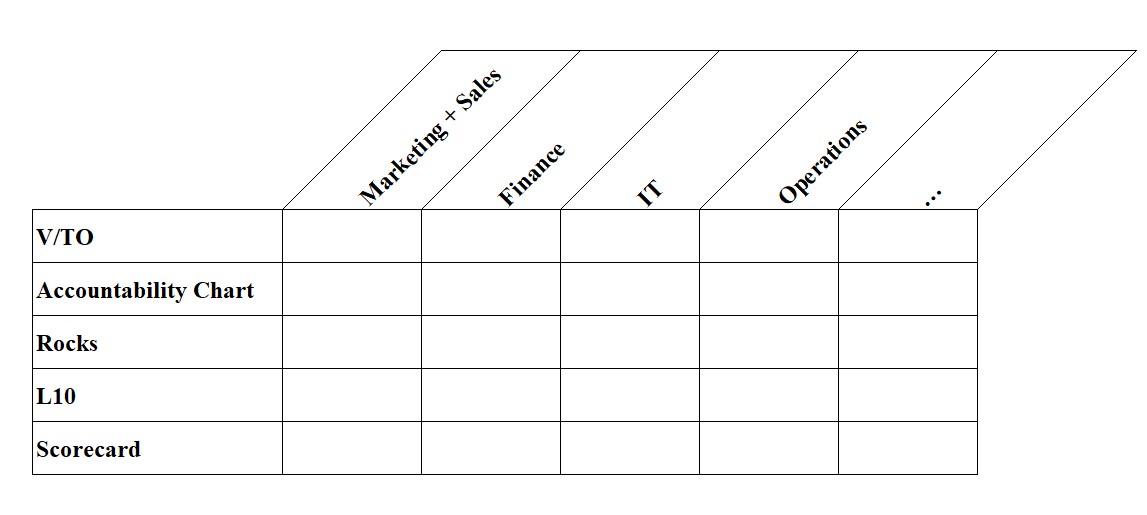
Over to you...
Enough read! If you want to learn how to swim, you have to jump into the water... 😉
Any doubts or questions, I’m here..
All the best for rolling out EOS!